In 1966 a PDP-8 was in use on the NINA synchrotron in addition to the IBM 1801 and central IBM 360/50. In 1968 there was also an Argus 400.
Quite a lot of PDP-11 and similar computers were used at the Laboratory over a long period of time. Many were used for experimental data collection and control.
PCP-11 machines and CAMAC interface equipment were also used to link the central computers (via the IBM 370/165) to a wide area network. The most users were at Manchester and Liverpool universities, plus other groups at Lancaster, Sheffield, Glasgow, Queen's Belfast and Oceanographic Sciences in Bidston (Wirral). Eight additional links were planned in 1979 including York, Warwick and New Ulster University (Coleraine). Access was also possible from the Rutherford Laboratory.
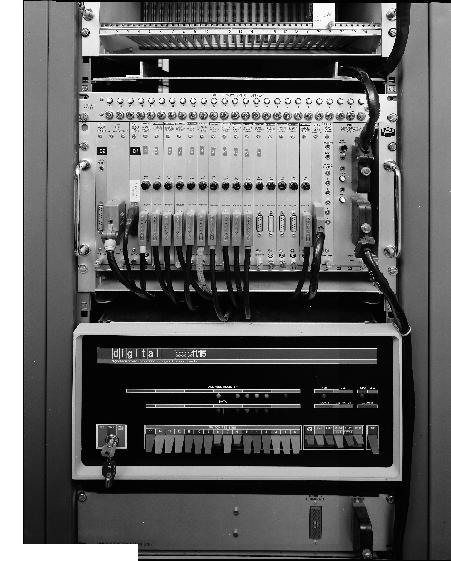
This photo of a PDP-11/15 in use at Daresbury dates from 1973. Note the well populated CAMAC crate above it.
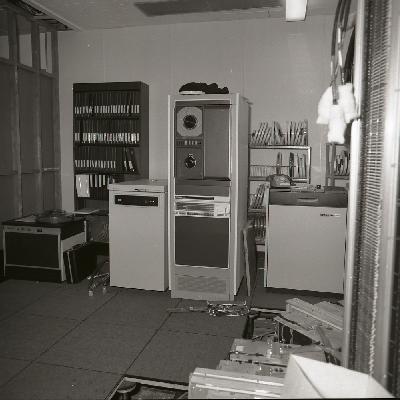
This looks like a different model in the Daresbury machine room in 1981.
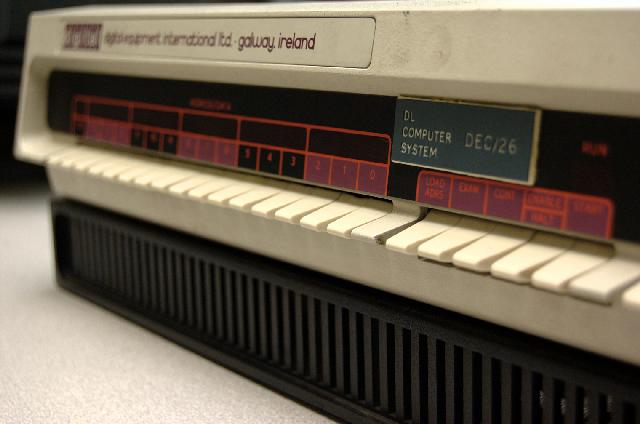
Some more pictures and facts for the PDP-11/05 at Daresbury in 1974.
This PDP is serial number 8204 built on 6/11/1974.

The next two pictures are from Dave Cable taken at the British Association of Science mini festival on 4/10/2009. For more pictures see Dave's Flickr site.
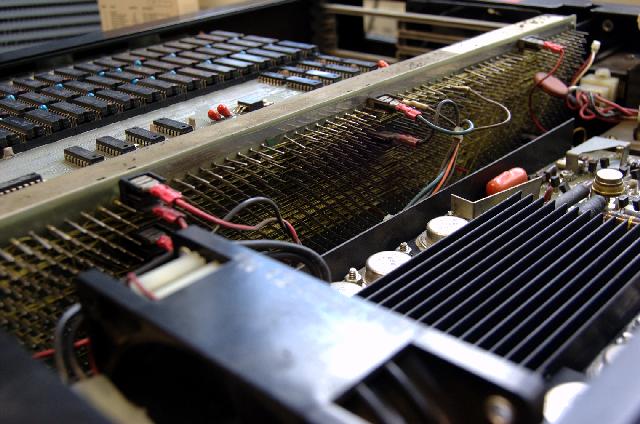
Modules
| Module | Description |
|---|---|
| M7260 | Data paths module |
| M7261 | Control logic module |
| G110 | purpose not known |
| G231 | 8K decode latch |
| H214 | 8K 16-bit stack |
We have recently found this machine which was used for data acquisition on the SRS. It looks like an LSI-11/23 with M-8186 KDF11-A CPU board from c.1981, so is probably a 22 bit machine. This had a 3.3 MHz clock.
The LSI-11 was manufactured from 1979 and intended as the successor of the PDP-11/03. It was based on the F-11 chipset, it had a double height KDF11-A processor card. It has a Q-Bus back plane allowing custom cards to be slotted into the chassis. The memory management was 22 bit (4 MB addressing space), but in some revisions (KDF11-A Rev. A) only 18 lines were used. The LSI-11/23 instruction set consists of 97 standard and 46 optional floating-point instructions. The microcycle time of the CPU is around 300 ns.
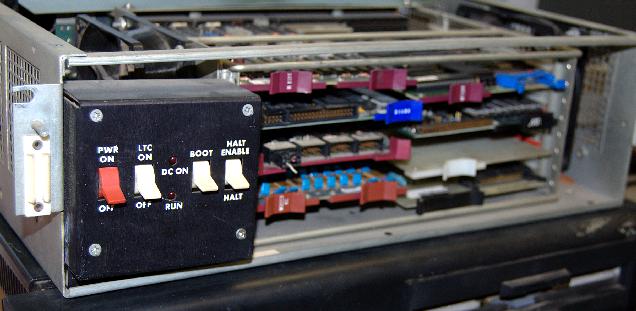
The first experiments on the Daresbury Synchrotron Radiation Source were controlled by 64kB LSI-11 processors [ACD1994, Bordas et al. 1986]. Later systems would use MicxoVAX or PCs attached to a CAMAC IEEE/488 interface.
LSI-11/23 Modules
| Left | Right |
|---|---|
| M-8186 (KDF11-A cpu) | M-7504 (ethernet) |
| DILOG (unknown) | AXV21 (unknown) |
| M-8043 (4-line async to serial link) | Sension Ltd. PCB 820C (unknown) |
| M-8059 KC (MOS memory) | HYTEC 1104-23 CAMAC interface card |
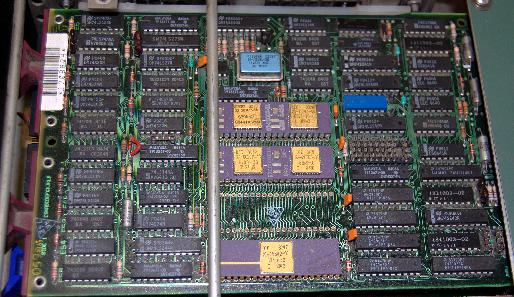
The KDF11-A module has four 40-pin sockets for the chipset. One is for the DCF11 two chip hybrid (21-15541-AB data path and 23-001C7 control chip), one's for the KTF11 MMU option (21-15542-01) and one's for the KEF11 floating point micro-code option (23-002C7 and 23-003C7, another two chip carrier). The MMU must be installed to use the FPP option). Ours has all three. This works with 18 and probably 22 bit addressing.
This system would have run under the RT-11 O/S. We have the accompanying disc unit with RT-11 base O/S 8 inch floppy.
We are currently seeking more information about CAMAC. The HYTEC 1104 interface card would have connected to a HYTEC 1000 executive crate controller.
A second similar machine was rescued on 9/11/2010. The cards in this machine indicates that it is from around 1982, but it may be as late as 1984.
LSI-11/23 Modules
| Left | Right |
|---|---|
| M-8186 (KDF11-A cpu) | M-7504 DEQNA (ethernet) |
| DILOG 57086B (unknown) | (unknown) |
| M-8043 (4-line async to serial link) | Sension Ltd. PCB 820C (unknown) |
| M-8059 KF (128k MOS memory) | Technical Magic (unknown) |
| Back |